Showing posts with label volunteering. Show all posts

Thursday, April 29, 2010

Preaching to the Choir?

The parasite infection investigation (subject of my last entry) was meant to be my primary project during my two weeks in Tarapoto. For better or worse, things didn’t turn out that way.

In place of the study, I spent the majority of my time preparing for and delivering talks in two Amazonian indigenous communities located two hours by motorcycle from URKU headquarters in Tarapoto. Once Daniel, the head of URKU, found out I had taught environmental science, he asked me to speak with the communities about climate change. He is organizing a World Bank-funded climate change project and study in the communities, and he felt I could help URKU get a head start.
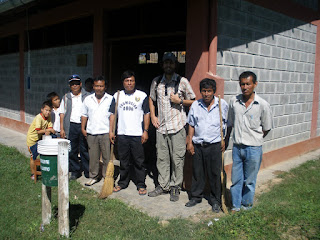
With the lapu (broom in hand), or mayor, and other community leaders in Colpa Sacha after they'd swept out the barn used as a community center where I would talk to 100-plus antzy primary school kids.

I struggled with the idea. “What can I say that would actually matter? They’re not the ones causing climate change. Aren’t there other, more pressing environmental challenges affecting their way of life?” In the end, though, I bought into the idea—the community needs to know what all the fuss is about, especially the kids. Also, I was told by one member of the Kawana-Sisa community that in the past mining industry representatives had lied to the community about mining risks and environmental consequences. Knowing some of the science could help fend off future attempts to deceitfully misinform.

I also decided to throw in my own tangential two cents. I was able to find a YouTube video to get this latter message across. The message: Through unified political activism, indigenous communities can make their voices heard, whether to fight environmental, health, or education problems. I joked with my mom the night before the presentation that I would be inciting revolt. We didn’t think the Peruvian government would appreciate the message I hoped to get across.

Instead of further reinventing the wheel, though, I have pasted an article I wrote for URKU (they want to inform the World Bank about our work in the communities) describing the visit we paid to the Colpa Sacha and Kawana-Sisa communities. But, before I do, I want to apologize for the length of the entry. Sorry!


Despite the small screen of the laptop, the small crowd of 15 gathered under the thatched roof was fully engaged. After the visitors’ presentation, with chickens and pigs scurrying around the dirt floor, the male-dominated audience told stories of the climate changes they’d observed firsthand and the pressure powerful oil companies were increasingly putting on the communities living on the hydrocarbon-rich land. They asked questions about the science and inquired about what all this talk of climate change and political activism means. Their refrain: “What can we do?” Throughout the meeting, the leader of the small group, a short, stocky man whose hardened feet went without shoes, sat at a table and, like someone who is intent on using what he is learning, took notes.

Such was the scene in the Kawana-Sisa indigenous community, located two hours by motorcycle from Tarapoto, Peru, on April 21 during a meeting between representatives of URKU, an environmentally-focused NGO headquartered in Tarapoto, and leaders of the village’s indigenous community. It was just one piece of a day full of sharing. Locals talked to a full-time URKU agronomist and an American Teach For America-trained Environmental Science teacher about pressing environmental issues, local healthcare accessibility, and struggles to find placement in post-secondary education for even their best students. Meanwhile, the URKU team focused their part of the exchanges—talking with two sets of students, a group of secondary school teachers, community leaders, and a night-time community-wide event in Colpa Sacha—on two themes: climate change and community activism.

Like the Kawana-Sisa leaders, the other groups were as attentive to the videos and speeches as they were passionate when sharing their stories. By all accounts, the meeting’s goals—to equip the two communities with both a better understanding of climate change and a model for future activism—were met. The day’s nightcap and main event was no exception. Despite being pushed back by two hours due to an electricity outage (perhaps to be expected when the current has only been running for two months), young, old, and in-between formed a densely packed semicircle on the grassy knoll of Colpa Sacha’s main plaza for the delayed presentation. The community members stood silently, intently gazing up at the images on the white sheet turned projector screen. Somehow, like the glow from the LCD projector, but unlike the trend one sees in the mainstream news, the future of this Amazonian indigenous community seemed to shine a bit brighter as the night, increasingly darker, wore on.

The nightcap.

For URKU, though work has only begun with Kawana-Sisa and Copal-Sacha recently, this was familiar territory. The organization frequently ventures outside the confines of its Tarapoto office, further into the Amazonian river basin, and does work with indigenous communities. URKU specializes in studies of Amazonia’s biodiversity, but URKU founder and chief operator Carlos Daniel Vecco is intent on reaching out and sharing the organization’s scientific knowledge with those most intently connected to the land.

The small, muscular leader of Kawana-Sisa has plans to assemble a federation of local indigenous leaders to address their communities’ concerns. Colpa Sacha’s leadership team has made the two-hour trek to URKU headquarters to talk about strengthening their relations. The indigenous communities are hungry for more—more collaboration, more assistance, more visits. URKU is eager to satiate them.

To keep up with URKU’s projects, studies, and their relationships with the Kawana-Sisa and Colpa-Sacha communities, visit their website at http://www.urkuperu.org/.

Tuesday, April 27, 2010

Parasite Infection Investigation in Tarapoto

When Eric Wetzel told me that URKU, the non-profit environmental organization in Tarapoto, Peru, was a place worth visiting, I could have signed up right then. You see, Eric, a biology professor at Wabash College, who has taught such esteemed individuals as…me, is someone I have a lot of confidence in. If he told me jumping from one of Crawfordsville, Indiana’s (the home of Wabash College) high-in-the-sky bridges, I would, at the least, have to go take a look and deliberate. With Eric’s recommendation and emails exchanged with the folks at URKU, I took the figurative leap and bought my 28-hour ticket to go north and east from Lima to Tarapoto.

Awaiting me and my two weeks in Tarapoto, a city of 80,000 inhabitants on the fringe of the Amazonian river basin and the foothills of the Andes, was work. My primary project started with a notebook over an inch thick that contains summaries of all patient visits for 2009. I would highlight all patient visits mentioning parasite infection. The doctor’s staff, then, would retrieve each highlighted patient history, and I would organize an Excel spreadsheet, entering relevant patient data. But, other than keeping me busy and away from cheap ice cream and treats, the point of all this?

Eric Wetzel and I in Lima. He went to Lima to work on creating a Global Health Program for Wabash College during his sabbatical. For three months he and his family lived in the Miraflores district. Juleen and I met up with him and his fam while we were volunteering at the Centro Ann Sullivan de Peru.

Dra Rosa, whose clinic had accumulated the patient data, and Eric are interested in generating a map of parasite infection levels in communities in and around Tarapoto. They’re hopeful that, through the study, they’ll be able to identify segments of the population that are particularly vulnerable to parasite infection. With both the map and infection prevalence data in hand, Dra Rosa and Eric will attempt to identify practices that are leading to high infection rates in certain populations, then wage a public health war against those practices. (More or less, isn’t that the plan?)

Say, for example, that Dra Rosa and Eric take a closer look at the infection of Necator or Ancylostoma parasites. These hookworms are impressive. Though they enter the body via the skin, often using the foot as a port of entry, they end up in the body’s small intestine. At one point on its road trip through the body, the hookworm induces the human host to cough, allowing it to covertly slip into the host’s esophagus. After getting itself swallowed, the hookworm will descend to its comfy and replete residence in your small intestine where it “leeches” blood and nutrients. The danger: anemia, especially probable and dangerous in the undernourished.

Flipping through patient histories, different records stapled one on top of another, struggling to make out the Spanish scribbles (apparently Peruvian med schools, like their American counterparts, teach their doctor candidates to write in chicken scratch), I had a feeling of greater purpose to push me through. And, even if I hadn’t, I knew this was something that Professor Wetzel might be able to use—no more motivation needed.

I came nowhere close to finishing all of 2009’s patient data. In fact, I only made it through January. Understandably, with their regular full load of work, the patient histories didn’t pour out of Dra Rosa’s staff. Still, a slow, steady, trickling really, stream came. The ball on this parasite infection investigation is rolling.

Luckily, in between entering data about patients infected with parasites, there was other work to be done. In addition to the parasite infection project, URKU had translating work and a radio debut for me. My biggest project, in fact, did not end up being the parasite data after all. Instead, the majority of my time was spent preparing for a visit I made to two indigenous communities midway through my second week. There, in a variety of very different sessions, I spoke to various groups about climate change and tried to incite the communities into political activism. More to come on that soon.

Here's a link to Professor Eric Wetzel's Wabash College blog (we're the subject of his last entry).

And here's a link to URKU's website.

Monday, April 19, 2010

The Old, Dusty, Roundabout Trail

Juleen left just over a week ago. Though, in our last blog entry, she suggested that our blog would be no more, she forgot one important thing: it's all the rage to resurrect oneself and come out of retirement. Christ was probably the original trend-setter. He was followed, a few thousand years later, by the likes of Ryne Sandberg, Michael Jordan, and, repeatedly, Brett Favre. Being the trendy type, I'm naturally following suit.

I wrote most of the following piece a few days into my stay in the north of Peru. Tarapoto, Peru is an interesting setting. Here I am volunteering for a total of two weeks. I am primarily doing two things: collecting and organizing parasite infection data and speaking with indigenous communities about climate change. Is Tarapoto as unique as I make it out to be or am I just cranky?


Another day and, though little was accomplished, the night beckons. The sidestreets are still of dust, and the dirtbikes and their brethren taxis still roar through the street, pale orange soil or otherwise. The stickiness is alive and well, too. After a few blocks, half uphill, of rapid walking the sweat begins to bleed through. In blotches, my grey shirt turns a shade darker. Even the delicious mint-chocolate chip ice cream couldn’t fend off the heat and its friend, sweat. This slow, dusty town is not strong on tourism, and I detest the weather, but it’s not all bad. Compared to the constant hassle of street vendors and beggars in Cuzco, this is paradise. Definitely wouldn’t mind the chill of Cuzco, though.

The Tarapoto, Peru Plaza Mayor.

Efficiency, as the cold, is not the order of the day here in Tarapoto. Perhaps the inhabitants have purposefully inserted squares where there should have been circles, slowing the gears, and keeping life from running as quickly as it could. Perhaps it would, at full speed, run away from them. Perhaps they’re weary of the heat and the sweat and, thus, intentionally add disorder to intentionally slow the pace. For me, the inefficiency is infuriating. Coupled with my frustration, each set of unnecessary added steps is another proverbial straw striking the camel’s back. It causes more, not less, sweat to pour out of me. My shirt darkens further.

Prime example: At the grocery store I ask for contact solution. The woman behind the counter grabs it, but, of course, she does not give it to me. Before making contact with the blue box that contains my solution, I must pay and get my receipt. After I pay, the cashier has another woman walk the solution to the distributor, a woman who checks receipts and hands out items. I must walk the 30 feet to the other side of the small store and wait in line to show my receipt to the distributor. I wait mostly patiently and fend off a rear attack by a potential cutter. With my receipt Xed, the distributor casually hands me my contact solution. Easy as pie!

The city sits on a grid. East-west streets around the plaza are paved. North-south streets, like this one upon which the URKU offices and, thus, my accommodations sit, are rarely paved, regardless of location.

Speaking of treats, after this consumer endurance test, I need an ice cream fix.

The ice cream kiosk sits at the entrance to this same grocery store. I approach the young woman. She is equipped with the scooper and access to twenty glorious, colorful flavors. I ask her which flavor is best. She starts to rattle the name of each. I cut her short. She confirms my suspicion; the green with a hint of darkness is mint-chocolate chip. I’m sold. “That one. Dos soles.” But she doesn’t handle money. She directs me to the cash registers where I must compete with all of the store’s customers and all of their items. All I want is an ice cream cone. Two soles. Mint chocolate chip! I hesitate, thinking about leaving the place just out of spite, and a bit of principal. “I can’t let them jerk my chain around like this! It’s ridiculous!” But I do. I want the mint-chocolate chip. It looks good, and it is.

Right behind these red doors? An upscale cafe on the Plaza Mayor that inexplicably closes during lunchtime hours.

I’m still conflicted about whether I should have bought the ice cream. But my experiences paying for printed documents and, later, trying to buy bread at lunchtime show me that unnecessary, painful, sweaty inefficiency is just how it is in Tarapoto.

Motorcycles and affixed chariots are the transportation mode du jour. I might sweat less if I took one.

Now, almost a week into my two-week stay in Tarapoto, I don’t let the city’s signature inefficiency bother me as much. It helps that I’m beginning to understand the calculus behind store openings and closures. Still, my bid to buy bread today, a Sunday, was nonchalantly denied. I am taking down hoops, but, still, there are plenty to jump through. Though I return to my small room dustier and damper than necessary, I usually enjoy the circus, or at least its ice cream payoffs.

An unrelated picture: My impromptu radio debut on Millenium Radio Sunday morning. Daniel, first from the right, surprised me with questions about why I'm here, what I've learned, and last words. I said that when I return to the US I'll be better at doing unexpected things, like surprise radio interviews in foreign languages. The guy in the deeper blue shirt translated everything into Quechua.

Friday, April 2, 2010

Washing Clothes: Latin American Style

Hello again!  Today we are writing you from the road, from our over-sized, soft seats in the VIP section of the bus taking us from Lima to Cuzco, Peru, to be exact. We justified the higher price by telling ourselves 20 hours in a bus is a long time worthy of a little more comfort than usual. Plus, Juleen has less than two weeks left in South America! Finally, after six months of frugal traveling, we’re breaking out. Well, minus how we wash our clothes…

We've made a choice to rebel against the shackles of the electricity grid and over-hyped machines and remarkably/ridiculously fragrant detergents. Instead of the industrialized washing process familiar to most Americans, we’ve opted for brute human force and a tennis ball-sized circle of soap. While we’re pretty sure our collective brute force has improved over the months, the soap is now but the size of a ping-pong ball.

To chronicle our manual clothes-washing efforts, we’ve done something a little bit different; we took a series of pictures of our daily clothes washing routine while we were volunteering at the Centro Ann Sullivan de Peru in Lima. Instead of a word-based blog, then, we’re hoping to make this one primarily feature pictures.


Juleen sorts through her laundry bag for the day's pickings. A "full load" of manually washed clothes is but a few items.


Juleen rinses the terrace-level tub out. A necessity given the fact that pigeons frequent the scene.


Juleen rubs the diminished ball of soap on her socks. Different clothes items require different soap application methods--shirts need it in the pits, underwear in the crotch, etc.


After soaping each item, we typically scrub the clothes individually, then collectively, as shown here. We're manual washers, not manual dryers. Lima's sun and wind took care of that for us.


Juleen's reacts to a washing job well done.


Tuesday, February 16, 2010

Living the OT dream!

For four great weeks, I led the occupational therapy dream! I was given the opportunity to rotate through several different settings, providing occupational therapy services and stumbling through Spanish. Here are highlights:

A couple mornings a week I went with a health clinic team to visit individuals with disabilities in the mountain-side communities. Seeing their living conditions and experiencing the adversity they deal with was a humbling, to say the least. The house pictured is where a young man of 26 years lives with his mom. He was the victim of a gun shot wound, years ago. Expanding my skill-set, I made him custom wrist supports to increase the function in his hands. This was a new experience for me as the splints were made out of plaster material. I must admit, I was proud of the product (see picture). While he was unsure of their benefits, we agreed that he’d give them a try for a while.

I also helped a new occupational therapist at a community program for kids who are deaf. A primary role at the center was speech therapy; however, many kids who are deaf or hard of hearing need assistance in regulating their sensations (which is where OT comes in). Since she was a new therapist, I provided more consultative services, making cheat sheets about treatment ideas for kids displaying different characteristics. See picture of the new therapist treating an 8 month old.

Another program took place once a week. A bus load of older adults (from the mountain-side communities) have a day of free services at the organization. Services I saw included: medical attention (including free meds), dental care, hair cuts, free food!, social activities (such as Bingo), respiratory therapy, physical therapy, and, while I was there, OT! I must admit, I loved helping with Bingo, but I was able to provide some one-on-one advice too. My highlight was working with wound care. A man (see photo) had a lower-leg burn that has been healing for 13 years. I’ve seen therapists complete wound care, but it was my first experience leading such an effort.
Alright, I’m writing too much. I also worked in two schools. Some OT was provided in groups and some individually.

In all, it was an incredible month for me.

I want to return.

Friday, February 12, 2010

Busting Our Butts in Bogota

A month ago we promised that all, with the start of our volunteering, would no longer be fun and games in Bogota. Admittedly, we had lived it up up to that point—partaking in the Colombian all-night party, i.e. rumba, albeit a version that ended at 12:30 instead of 6:30am; being tourists; getting whipped in tennis (it was my first time on a clay court!); enjoying microbrews at the Bogota Beer Company; and, generally, letting ourselves be spoiled by Juliana and Diego and their two maids. Though we have found time for a bit of fun and a few games (of futbol) since, the past few weeks have corroborated our claim. But, if it hasn’t been all leisure, what have we been up to?

Among the two of us, Joe has had less on his plate, except at lunch, so we’ll start with him. He…okay, I’m switching to “I”; the third person feels funny. My primary responsibility has been to take over various teachers’ classes, presenting lessons on environmental topics. I spent most of the time discussing climate change—what it is, what it’s caused by, and what are some things we can do to limit our “carbon footprint”. Interestingly, I’ve had the opportunity to have this discussion with a wide range of age groups. In the end, though I felt like an actor in front of them, I enjoyed the third-graders most. The oldest girls were fun, too, but for a different reason, and the middle school-aged girls were, well, interesting. And, yes, I meant to put “girls” back there. Santa Pachas is an all-girls school, pre-kindergarten through high school. When it comes to single-sex education, I concede, I was biased to begin with, having gone to the all-male Wabash College. I am now further convinced that single-sex education can be a great thing, and perhaps an even better thing in primary and secondary schooling.

In addition to the teaching, I led discussions of environmental topics within a conservation club on Fridays, and I worked with the woman in charge of professional development at CASFA, the younger, less successful version of our main workplace, Santa Pachas. A better introduction to this school, reminiscent of my former teaching grounds in Chicago, is in order.

CASFA serves a different class of student than Santa Pachas, and I mean class in the socioeconomic sense. Located farther up the mountain, part of the poorer, northward urban sprawl of Bogota, CASFA’s loud, painfully urban environs provide quite the contrast to the lush, tranquil campus of Santa Pachas. And it’s not just a difference of setting; the resources of the average CASFA student pale in comparison to the relatively affluent Pacha chica. Sadly, as is too often the case, the quality of the instruction within the two schools is, at least for the moment, directly correlated with the financial resources of the institution and its clientele. (Pachas does nobly provide financial support to its younger sibling, CASFA, to help curb the gap.)

Juleen and I spent our Thursday’s at CASFA, struggling with the disparity. Those Thursdays provided a few headaches, and they provided substance for the recommendations I ultimately gave to the school´s professional development coordinator. Impressively, she received all of my ideas graciously and encouraged me to provide more.

That´s what I have been up to. While not leisurely, it’s been great (most days) to have something to do and to feel productive again. It had been a while.

And Juleen has been even busier than I. Her story and relevant pictures are on their way. Right, come back soon.

Wednesday, January 27, 2010

Alert: Teachers drinking at school!

I hated meetings at the school where I taught in Chicago. They were boring, unproductive, and didn't provide us with booze. Here at the school where we're volunteering, they don't have the same problem.

Sunday was the principal's birthday. Monday after the school day, naturally, was the party in the cafeteria to celebrate. Really good cake and white wine were served (you could even get refills!) while teachers and staff danced, sang, and joked the afternoon away.

The differences in staff camaraderie (everyone was having a GREAT time), resource management, and policy on alcohol shown by Monday's fiesta are just a few of the innumerable and grander distinctions separating my former school in Chicago from Bogota's Santa Francisca Romana, a Catholic all-girls school.


Juleen and I out-danced this couple seconds later, a la John Travolta and...the woman in...that one movie.

Saturday, January 16, 2010

Bogota

Mountains to the east. A whole ridge of them. City sprawling everywhere else. City lights illuminate the night sky, off into the horizon and beyond. Runners and bikers pass along the CicloRuta, the special street lanes designated for these over-achievers. The 21st-century public transit system, TransMilenio, provides fast and mostly efficient transport to many parts of the city. Museums, cultural events, a beautiful mile-high-plus setting. We've passed the last few days here in Bogota, Colombia. The next month-plus promises to feature more than fun and games.

Starting Monday the leisure--morning tennis, Avatar in 3D, for example--stops. We have our six-day volunteer week (as opposed to work week) in hand. We go to live at the convent tomorrow, passing a few days there before starting our first homestay.


The Christmas Tree still adorns Bogota's Plaza Bolivar in front of the national congressional building.


Note the two TransMilenio buses scurrying north in the lanes reserved for them. Also note the line of more than fifty people waiting to buy tickets for the TransMilenio from the one person selling them. Luckily we had just gotten off the system and weren't interested in using it.


Us in front of the aforementioned national congressional building in historic downtown Bogota.

Friday, December 18, 2009

Map Update I

Now that we’re established in a new country—Costa Rica—it’s everybody’s favorite blog time: map update time! We’re including just the legend for places we visited in Nicaragua. If you want to see the legend for locations 1 through 14, you’ll have to scroll down and look at our last map update. Click on blog entries for November.

As you’ll see below, Nicaragua was a worthwhile destination for us. To preview, we met awesome people that are due to become lifelong friends, some through impressively random encounters. And, notably, we had a couple diverse and extremely informative volunteer opportunities.

15 – 10/31 to 11/25 – Leon, Nicaragua. A young town bustling with a small ex-pat scene. We lived at the headquarters of QuetzalTrekkers, a volunteer-run organization that leads hikes up volcanoes and donates all proceeds to local charities. During the three weeks we were there, we busied ourselves with various projects ranging from hanging shelves, to finding a local peanut butter source, to working with street kids at Las Tias.

16 – 11/25 to 11/27 – Jinotega, Nicaragua. A respite from Leon both as regards climate (it’s cool) and tourism (there’s very little). We stopped in this mountain for two nights and busied ourselves with computer stuff. Here Joe became a journalist.

17 – 11/27 to 11/28 – Masaya, Nicaragua. To celebrate Thanksgiving night we had pizza in Masaya, famous for its artisanal crafts and markets. Joe’s “fake wallet” stolen .

18 – 11/28 to 11/30 – Laguna de Apoyo, Nicaragua. Small world: Our CouchSurfing host was the son of a patient Juleen served in Chicago. We stayed in his mini-mansion, toured his finca, ate amazing food, and delighted in conversation about our Midwestern roots.

19 – 11/30 to 12/01 – Playa del Coco, Nicaragua. A random ride made us friends with Laurie, an amazing person and New York City lawyer. Half-Nicaraguan, her family holds onto a glorious beach house on a beautiful, sparsely populated piece of Nicaragua’s Pacific coast. We gladly kept her company for the night.

20 – 12/01 to 12/09 – Isla de Ometepe, Nicaragua. Two volcanoes dot the center of the figure eight shape this island makes. We roughed it for the week at Project Bona Fide. Most rustic week of each of our lives. Very educational. The people made the experience.

21 – arrived 12/09 – Liberia, Costa Rica. Only a few kilometers into Costa Rican territory, the difference between this place and everywhere else we have been is stark. Lights shine brighter. Skin is fairer. Streets are cleaner. Prices more painful. Our wallets will not allow us to leisurely take in Costa Rica.

Despite its harsh reputation, its reputation particularly with Americans that is, Nicaragua both entertaining and interesting. For anyone looking to go south to travel, live, or whatever, we recommend it.

Monday, December 14, 2009

Permaculture

We spent one week on the Isla de Ometepe, an island in Nicaragua. While there we lived and worked on a farm owned and operated by two Americans. We could feel good about the $20 a day we paid to volunteer because we were learning, and, perhaps even more importantly, because the farm was purportedly organic and sustainable (admittedly, the money covered our food too). In other words, the farm was practicing “permaculture”.

Permaculture is short for permanent agriculture where the intent of preserving and conserving nature’s resources, while providing for oneself. For example, many American farms just plant one crop. They only have corn or soybeans or wheat or even canola! They have a monoculture. Because monocultures can quickly exhaust soil’s resources and allow for soil to erode, most farms apply annual doses of synthetic, unnatural fertilizers to the soil. The fertilizers ensure that the crop can obtain its required nutrients, and thus grow. Synthetic fertilizers are made using oil, so using them is considered inorganic and (in the long run) unsustainable farming.

Project Bona Fide does things differently. Instead of using synthetic fertilizers, the farm makes its own fertilizers: both from plants it grows specifically for the purpose and from food and animal waste combined with dead plants. Another advantage of Bona Fide’s non-monoculture system is that they use more than one potential growing “level”. Imagine a beautiful Indiana landscape, i.e. a big field of corn. Is there anything growing above the corn? Is there anything growing below the corn? Typically the answer is no. Bona Fide takes advantages of the different growing “levels” by growing plants with different shade tolerances together: a shorter herb and a mid-level legume plant to fix nitrogen and a taller papaya tree. In this way, Bona Fide grows a more diverse set of crops and avoids overtaxing the soil.

Another cool aspect of permaculture is its insistence on time and energy efficiency (a term from our Kiwi friend and permaculturer, Richard). Basically you put things in a place that will save you time and energy down the road. Put foods you use a lot close to your house. Put foods you don’t use a lot farther away. Definitely sounds good, huh?

That’s kind of the problem, though: it sounds good, but what does it look like in practice. And, of course, different strokes for different folks: your idea of permaculture probably doesn’t equate with mine. Along those lines, we spent most of our week at Bone Fide critiquing the place. Why don’t they grow “food”? What’s its true goal? Etc...

On our last night we got an awesome tour (thanks, Chris!) of the farm. While we wouldn’t have done everything the same way, at least their system made a lot more sense. With a better understanding of Bona Fide we could feel better about the money and time we were donating to the project.

If we can extrapolate what we found from our experience at Bona Fide, it seems to inform the experiences we’ve had at Bona Fide and, potentially, elsewhere (as discussed in our previous blog). A little communication goes a long way between volunteer and non-profit goes a long way! Who knew?

Saturday, December 5, 2009

Non-Profits

Non-profit organization. What do you think of? I tend to think of an idealistic organization, a place doing good work. Ultimately, a place I’d probably like to work.

A volunteer-run non-profit. Sounds even better. And if the money supports a separate organization providing essential services to the community that’s better still. Of course I’d want to work there! Right?

In reflecting on our past work and the work we’re doing now, one common theme shines brighter than any others—all six organizations have been non-profit organizations. We certainly hadn’t planned it out this way. Well, to be truthful, we didn’t plan the trip itself, including the volunteer opportunities. But it’s cool that it has worked out this way. Both of our career paths, whatever they decide to be, could foreseeably include work with non-profit organizations. Beyond any personal benefit, familiarizing ourselves with the various organizations and subsequently critiquing them has been extremely interesting.

At the moment we’re volunteering at Project Bona Fide, a non-profit working to develop a fully organic, fully sustainable farm (i.e. a permaculture farm) on a strip of land here on the Isla de Ometepe in southern Nicaragua. Bona Fide seems perfect for us: there’s work to do; there’s farming to learn about; there are a few other, like-minded people around the place (so we’re not constantly staring at one another); and you’re done with work at noon! But we can’t unconditionally support the place. What’s the problem? Good question. Maybe it’s just the fact that we’re paying $20 a day ($10 per person) to volunteer. Maybe it’s that the food system is disorganized. Food is included in what we pay, but we don’t feel that the kitchen is amply stocked for us (Juleen asked for tea… the answer was no). Maybe it’s that the goal of the farm is unclear. After nine years under the current owner, it still depends on volunteer’s fees to stay afloat. For seeking sustainability, the farm grows an alarmingly few number of the foods it consumes. We’ve heard the owners might want it to function as an education center; however, the accommodations are rather barren.

In Leon, Nicaragua we experienced similar frustrations with various non-profit organizations. A woman representing a pro-woman’s group didn’t respect the meeting she setup with us. Consequently we weren’t able to work with the organization. A community group providing a safe place for street kids scoffed when we offered to start an afternoon class. Our attempts to assist Quetzaltrekkers were hindered by unclear expectations for management and volunteers alike.

So are we just whiney and overly critical? Well, yes. You know that. But more appears to be at play here. We’ve had great experiences and are thankful to have learned a lot through our volunteer experiences. And we’re not going to give up on them yet; we’ll keep seeking out work with non-profit groups along the way. We are surprised, though, that we cannot unconditionally recommend any of the non-profits we’ve worked with. Aren’t non-profits organizations better than this?

Next stop: corporate Costa Rica!